How many cyber attacks are there in Switzerland? facts and figures

How many cyber attacks are there in Switzerland? facts and figures

The latest figures are available for the 2019 annual review. According to Statista, 388,939 cybercrime incidents were registered in August 2019. That was significantly fewer than in January of that year, when 442,276 cases had been registered. The perpetrators were particularly active in the area of networks and attacked corporate and private networks. Infected advertising banners, however, became rarer.

Study results bring the danger to light

SVV, ICTswitzerland, ISB, ISSS and SVV carried out a joint study that looked at cyber attacks. The result was frightening: more than a third of all companies surveyed had already been affected by a cyber attack, but only four percent see it as a great danger to be hit again by such an attack and to see their own existence threatened.

The experts were shocked by the carelessness and the high number of cyber attacks. The main results of the study said:

    • around 62 percent of companies demand that IT always work reliably because this is seen as very important for their own company
    • around four percent of all SMEs in Switzerland have already been affected by blackmail, and around 36 percent have already struggled with malware
    • Cyber risks are greatly underestimated; more than half of the managing directors surveyed (56 percent of 300 companies) saw their own company as being well protected against hacker attacks
    • Protection against cyber attacks is still not sufficient (60 percent protect themselves against malware with a firewall and regular backups, only around 20 percent of companies have systems that detect cyber incidents, only 18 percent of companies rely on processes to handle the Internet attacks)
    • only around 15 percent of all employees are trained to use IT safely

Imaginative criminals?

Just spying on sensitive data is no longer the only way cybercriminals take. Among other things, they rely on ransomware and thus block access to the computer of the company or a private person.

The PC will only be activated again after the ransom has been paid. This is a scam that is also often used to extort Bitcoins or other crypto currencies. However, there are defense programs that prevent such software or its execution. However, this defense software is used too seldom by companies.

In general, the companies are still too unprotected. While the basic cyber protection measures have improved significantly and around 60 percent are using protection against malware, a firewall and backups, the other possible measures can still be expanded. This is very surprising, because in mid-2017 many Swiss companies became victims of a cyber attack by ransomware software.

Even large companies like Merck, Reckitt Benckiser and Beiersdorf were paralyzed by "NotPetya", an encryption Trojan. The effects were felt for months. The Mondelez group, which was also affected, stated at the time that sales in the second quarter had been lost by around half of the usual growth.

By the end of 2017, the damage caused by the Trojan was estimated at up to 84 million US dollars, and soon the sum of 100 million US dollars was in the room. More than 1,700 servers and 24,000 laptops were damaged. Other companies even reported damages of up to 300 million US dollars.

divide

Insurance for SMEs

Compare all providers in Switzerland quickly and free of charge.

These articles might also interest you:

Who Needs Cyber Insurance?

Who Needs Cyber Insurance?

Basically: Cyber insurance is necessary for all those who work with the Internet and cannot or do not want to bear financial losses due to hacker attacks or other damage that can occur through global networking. Cyber insurance is recommended for both companies and private individuals.

Cyber insurance for companies: protection in the face of increasing digitalization

We remember: A few years ago there were only computers in offices or there were PCs that controlled a company's machines and systems. They were all not connected to one another, the computers were neither connected to the company network nor to non-company computers or servers.

Today it looks different and there is hardly a PC left that is not networked. Everything is based on networks which, despite all computer security, are not always and in every place really safe. Last but not least, the human being as a user represents a risk factor that can neither be ruled out nor really calculated.

Cyber insurance makes sense for all companies that rely on strong internal and external networking and that will continue to rely on digitalization in the future. Basic rule: The more the business depends on how efficient the IT is or how well it works, the more important it is to have appropriate insurance. It protects against personal and third-party damage and protects a company from possible bankruptcy due to high compensation payments with simultaneous company downtime.

It has to be honestly said that a company is already vulnerable if it only relies on online banking, if it transmits accounting data online to the tax office or if it is telephoned over the Internet. If hackers want to break into the network, they can do it! Good for the company, which is then covered and at least the financial damage is compensated.

Cyber insurance also makes sense for private individuals?

Private individuals who frequently use the Internet should also consider cyber insurance. They are also dependent on achieving the best possible protection for their activities, although common virus protection programs are not always helpful.

If, for example, booking errors occur when shopping online, goods ordered are not delivered or someone else orders from an online shop via their own purchasing account, insurance is actually helpful. The damage is limited to CHF 10,000, for example, which should, however, adequately protect most online orders.

Social networks are also a high risk, as accounts are often copied and used for illegal purposes. Identity theft can go so far that financial transactions are carried out in the name of the person being stolen? the costs are borne by the victim.

Cyber insurance is therefore also strongly recommended for private individuals, provided that they frequently use the Internet or do their shopping there. Since the cyber insurance also covers the costs of data recovery, it is also helpful for private individuals in the event of a damaged hard drive by a hacker attack.

However, it is important to read the terms and conditions of the insurers and to be aware of all exclusions and restrictions on benefits before signing the insurance contract. Here at neotralo.ch you can compare the providers!

divide

Insurance for SMEs

Compare all providers in Switzerland quickly and free of charge.

These articles might also interest you:

What is cyber insurance?

What is cyber insurance?

The devices, systems and machines of a company are increasingly networked with one another. This ensures significantly increased efficiency at work, but at the same time increases the risk of cyber attacks with sometimes serious consequences. Cyber insurance protects against hacker attacks and, for example, replaces financial loss, damage caused by business interruption and extraordinary costs that cannot be calculated. Cyber insurance is now also available to private individuals.

Cyber insurance for companies: protection against high costs

Not only that a hacker attack can be responsible for a standstill of the entire production and thus for high sales losses. Above all, the cyber attack can result in incalculable costs that also extend to the company network and customers.

But cyber insurance does not only cover attacks from outside. Employees who pass on sensitive data or install defective software can also cause major damage, which is covered by cyber insurance. Both personal and liability losses are insured, the latter being limited to pure financial losses and immaterial losses. The costs for legal advice are also covered.

Cyber insurance has a big plus because it not only pays when direct damage has occurred, but it also pays for indirect damage. These arise, for example, when there is a complete loss of data. Downtimes in production can also result in high costs for a company, which, however, can be borne thanks to the insurance. The protection of cyber insurance for companies thus goes well beyond IT system insurance.

Cyber insurance for private individuals: everyday claims covered

Not only are companies increasingly working digitally, the everyday life of the Swiss is also increasingly determined by computer technology. Cyber insurers have recognized this and have long been offering corresponding insurance for private customers. These are often available as an addition to normal household insurance, and legal expenses insurance sometimes also includes cyber insurance.

Some insurers, however, now also offer individual insurance. This covers the typical damage cases:

    • Data loss
    • Theft of one's identity
    • Damage from online shopping
    • Personality violations

In addition, legal protection insurance services are usually provided so that legal advice and representation are also included in the scope of services of the cyber insurance. However, these benefits are usually rather scarce, so that they are often not sufficiently high in an actual legal dispute.


Damages in connection with online shopping are not offered by all insurers. In addition, the amount of cover is usually limited, for example to 10,000 francs. Wrong deliveries, damage or missing deliveries are then insured.

The benefits are usually capped when it comes to protection against identity theft. Some insurers explicitly exclude damage from online or mobile banking. Anyone who wants to protect themselves as a private person with cyber insurance against damage that can result from the use of the Internet should therefore take a close look.

Not all providers offer really sensible policies, some set the performance limits clearly too tight. This still leaves a large part of the costs with the insured.

Conclusion: Before getting cyber insurance? regardless of whether for a company or as a private person? the providers should definitely be compared here on neotralo.ch in terms of services and premiums!

divide

Insurance for SMEs

Compare all providers in Switzerland quickly and free of charge.

These articles might also interest you:

Turn on innovation: neutral virtual insurance comparison

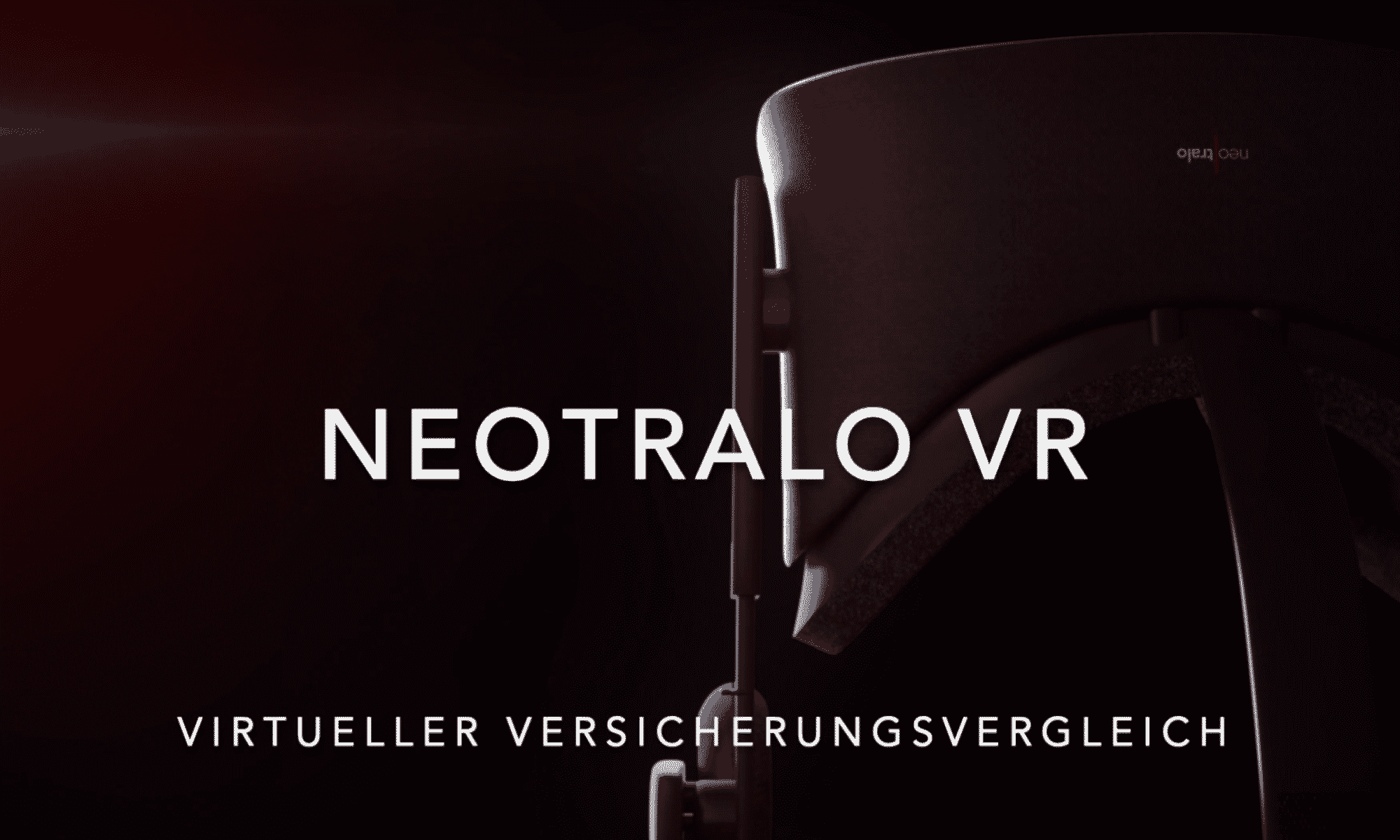
The neotralo VR App: Virtual insurance comparison

The neotralo VR App: Virtual insurance comparison

Virtual Reality may have calmed down, but the revolutionary approach remains. Digital content is presented in a tangible way to the consumer and global corporations bring their products closer to their customers with VR. This is where neotralo.ch joins and presents a whole new world of insurance comparisons with the neotralo VP app.

Promo video for the innovation award of the Swiss insurance industry

Play Video

What does virtual reality actually mean?

The world was enthusiastic about the innovations around virtual reality and the huge potential of technology for communication, entertainment, education, research and medicine is undisputed. Thanks to special hardware and software, it is possible to create an artificial reality, which was not possible with the previous 3D possibilities.

The core of the VR hardware is the glasses of the same name, which are used to display artificial images to the user. In order to record the location and position of the user, the glasses are equipped with special sensors. Thanks to sensors and the display of the images, the user gets the impression of being present in virtual reality.

We at neotralo have made use of this approach and developed a special application. We enable insurance comparisons in a new dimension!

Who invented it?

Everyone knows the saying from advertising for herbal sweets. But the answer to the question is also correct in our case! ?The Swiss? we are from neotralo and we are the first to have developed such an app for comparing insurance.

You only need the right hardware, which is offered in different versions by the company Oculus, for example. The app runs on the headset and you can now compare different insurance policies. ? neotralo VR? is the name of the app that is so far unique and that is not available on any other comparison portal.

Why should comparing insurance policies remain as boring as usual? Why always enter the same numbers and data in order to find the best provider before every new insurance or after a premium increase? Thanks to neotralo VR, it is now possible to combine comparing insurance with the fun of new technology.

Each user gets access to his own virtual world, in which it is really fun to compare the insurance companies with each other. Turn a chore into a game you'll want to play over and over again. You will soon be wondering when the next reason to compare the insurance companies will finally come.

How does the neotralo VR app work?

Imagine: you live in the real world and need to take out new insurance. Perhaps you also received an insurance notice stating an increase in premiums.

Now it's time to quickly find another provider who offers far better conditions.To do this, you go into the virtual world and compare the various insurance companies with fun and effortlessly. You can even take out the selected insurance there and return from the virtual to the real world. You counter this with your new insurance, which of course applies in the real world. Implementing this idea doesn't cost you much.

First you need the headset and the neotralo VR app. No more, because now the fun can already begin.

The prices that are shown to you as part of the comparison are always up-to-date and are calculated in real time. Here you can compare your insurances for yourself, for the protection of valuables, vehicles or business assets. A comparison could hardly be easier and certainly not more entertaining.

Gone are the days of stubborn data entry, today the insurance comparison is carried out virtually! You then use the results in the real world, because the insurance you choose virtually also applies here, of course.

What is special about the neotralo VR app?

If the points mentioned above are not enough for you, we have another special feature to offer you. These will be fans of the film? Minority Report? know and therefore appreciate them all the more. But all other users will soon be convinced: We are talking about using the app without a joystick. It recognizes the movements of the hand directly and implements them. The app is very easy to control.

What's next?

We are currently in the process of registering the neotralo VR app for the Swiss Insurance Award. With this innovation award, the winners and the other participants have the opportunity to present themselves as an innovative company and to position themselves as a modern provider to customers.

We are very excited to see how the app will be received there and what feedback we will receive! We will of course keep you up to date on developments and will also present the outcome of our application here.

In view of the very positive criticism so far, however, we also expect positive feedback from the Swiss Insurance Award. After all, the app has been so well received so far that we are already developing a new version of it.

Because: Improvements are of course always possible, and since we have set ourselves the goal of revolutionizing the world of Swiss insurance and their products, we are constantly looking for innovations and changes in your favor.

We will incorporate these changes in the second version of the application, which you will soon receive free of charge as well as the first version.

Where can the app be tested?

Anyone interested in the app can visit us in Zurich Altstetten and test the neotralo VR app. Free of charge, of course! Simply write us an e-mail to info@neotralo.ch so that we can also advise you when you are with us for your test appointment. We look forward to you and your test.

divide

compare insurances

Compare and optimize now.

These articles might also interest you:

Company formation: 4 Swiss providers compared

Company formation: 4 Swiss providers compared

Those who want to start a company in Switzerland do not have to fight their way through alone. Various start-up providers support the young entrepreneur on his first steps towards independence and provide comprehensive services at different prices. The following lists compare the providers startups.ch, erfolggruenden.ch, swissregistration.ch and moneyhouse.ch with prices and services offered.

criteriastartups.chSuccessfulgruenden.chSwissregistration.chMoneyhouse.ch
Price incl. VAT.CHF 645CHF 775CHF 780CHF 808
Incl. Commercial register feesNoNoNoNo
Cost of authentication signatureCHF 10 - 100CHF 10CHF 10CHF 10 - 100
Creation of the foundation documentsYesYesYesYes
Notarial certificationYesYesYesYes
Free HR correctionYesYesYesYes
Download information sheets for foundersYesYesNoNo
Checklists for the foundationYesYesNoNo
Step-by-step worklistsYesYesNoNo
Advice via video chatYesYesNoNo
Course to be takenYesNoNoNo
Personal adviceyes, max 1 houryes, more than 1 hourYesa
Checking company name for legal certaintyYesYesYesYes
VAT registrationYesYesNoNo
Formulation of a company purposeYesYesNoYes
Advice on the company name from a marketing perspectiveNoYesNoYes
Check availability company nameNoYesNoNo
Marketing adviceNoYesNoNo
Error correction in the foundation formYesYesYesYes
Interview protocol and recommendations for actionNoYesNoNo
Advice after foundingyes, if there is still 1h leftYesNoYes
Help with creating terms and conditions, logo, website etc.YesYesNoNo

As the table above shows, none of the start-up providers in Switzerland offer all the services that are relevant for a business start-up. From the consideration of the performance comparison, the conclusion can be drawn that founders can get the most extensive benefits from startups.ch and from sucessgruenden.ch.

With 645 and 775 Swiss francs, these two providers are also the cheapest in our comparison. However, the price stated at startups.ch only applies to basic services. Depending on the package booked, the prices may differ, the above offers only an approximate guide. If signatures have to be certified, founders pay the least with the providers successfulgruenden.ch and swissregistration.ch.

How do I find the best individual provider?

Every founder should know what is important to him personally:

    • What services can I provide on my own?
    • Which formalities do I need help with?
    • Do I need help creating a website?
    • Do I want to have advice after the actual start-up process?

If you want to be supported particularly comprehensively in the start-up process and also want to take a course, startups.ch is particularly good advice. Successful-gruenden.ch still offers video advice.

The advice at startups.ch is limited to one hour, later you can only use what is left of the one hour. Here, other start-up providers are much more accommodating, because there is no limit to the advice at moneyhouse.ch.

Who is in which position in the ranking?

The various start-up providers rank differently, depending on whether the prices or the services are evaluated. In terms of price, startups.ch is of course at the top and therefore presents itself in first place.

The provider is followed by successfulgruenden.ch, followed by swissregistration.ch and moneyhouse.ch.

However, if a ranking is now created regarding the performance, the ranks change significantly. Successgruenden.ch slips to first place because the services offered by this provider are particularly comprehensive and start-up-friendly.

Startups.ch is now only in second place, the provider is weak in terms of advice on the company name and in terms of free marketing advice. These services are not specified here. In addition, startups.ch does not pass on any recommendations for action to the founder and does not prepare a free conversation log.

In third place we now find moneyhouse.ch, in terms of performance there are enormous differences to the two previous providers. This also applies to swissregistration.ch in fourth place. This start-up provider takes itself out of the entire phase of the start-up preparation and does not offer checklists, information sheets or video advice. This also applies to moneyhouse.ch, but this provider scores again with the points of free formulation of the company purpose and with advice on the company name.

Consultations are also offered after the foundation. These points lead to an upgrade and thus to third place in our ranking.

You need help choosing a startup provider insurance for companies or do you want to know more about what is important when founding your own company in Switzerland? Please contact us, we will be happy to advise you!

divide

These articles might also interest you:

The 10 most common mistakes when starting a company

The 10 most common mistakes when starting a company

The following errors are particularly common when founding a company in Switzerland. It was so easy to avoid!

1. Quickly design a logo

Many founders want to complete their letters and their website as quickly as possible. You design a logo for your young company before you have a commercial register entry. However, it later turns out that the company name may not be used for legal reasons.

The founder must determine a new name and now explain why the name and his logo have changed. The expenses incurred have been in vain, and it also does not shed light on the founder if he acts in such a hasty manner.

2. Don't create a business plan

The business plan forms the basis for the company's further financial planning and provides an overview of where the company would like to be in a few years. In addition, the business plan is the basis for applying for company loans and public grants.

Those who do not have such a plan on hand lose sight of their goal. Important: The business plan should include an analysis of the competition.

3. Don't worry about finances

This mistake is almost more serious than the lack of a business plan. After all, survival as a company depends on it! Only the entrepreneur who knows exactly what income he is generating and what expenses are to be borne can properly plan his budget.

He is not surprised by the current financial situation and is able to make important decisions at any time. If you do not have your finances well under control, you should get an accountant or tax advisor aside.

4. Do not apply for a VAT number

If the turnover is less than CHF 100,000, no entrepreneur is obliged to apply for a VAT number. Conversely, this also means that he cannot invoice VAT. In many cases it therefore makes sense to voluntarily apply for the VAT number and in return to be able to use the effective accounting method.

As part of this, you will be reimbursed for the input tax that you had to pay on your expenses. This is particularly important in the context of larger investments.

5. No marketing strategy

Customers are the most important thing for every company. Therefore, make sure that there are always enough customers! Do not neglect the acquisition and look for a marketing strategy.

Pay attention to where you best reach your target group and use the social media opportunities for yourself. You have to determine why your customers should buy from you and not from the competition. Then you can build a marketing strategy.

6. Don't give yourself a break

Every young entrepreneur knows that the beginning is pure stress. The long working hours are exhausting and soon you will feel exhausted and completely exhausted. However, those who do not stop in time run the risk of slipping into a burnout.

It is therefore important to know right from the start how order peaks can be intercepted and what can be done so that you, as an entrepreneur, can also take a break.

7. Do not employ staff

The idea behind it is understandable: employees cost money, their wages first have to be earned. But that is thought too short. On the one hand, a company grows with a suitable team that works well together internally and brings as much specialist knowledge as possible into the company. On the other hand, the range of services can be significantly increased if the work is on multiple shoulders.

In addition, personnel costs can be claimed for tax purposes and reduce the taxable profit. As a result, the costs are not just on the shoulders of the entrepreneur.

8. Ignore competitors

Many young entrepreneurs are enthusiastic about their idea and oversleep the fact that other entrepreneurs also have great ideas. If the idea is the same, the ice on which the entrepreneur moves is very thin.

He must ensure that he has a unique selling proposition that can be used for marketing purposes. Competition has to be observed in order to be able to react directly to changes in the market.

9. Set goals that are too high

A great ambition is understandable, but even a very motivated young entrepreneur should take care not to overstretch the curve. Those who take over risk their health and then fall back quite a bit.

It is important that every entrepreneur thinks about what he can do himself and understand professionally. For everything else, he should get expert help on board. Good staff is the most important resource in the company.

10. Do not set up a foundation agreement

Of course, when good acquaintances or former colleagues found a GmbH, they do not assume that the wind can change and they no longer understand each other. But unexpectedly comes often and it is always recommended to write down all regulations and agreements.

Above all, it is about regulating the financial aspects: How are the ordinary shares valued? Who is liable for what amount of liabilities? Possible exit scenarios for the shareholders should also be regulated in writing. It is ideal to set up a shareholder agreement immediately after the foundation or even before. A notary will also be happy to advise you on this, who will formulate all regulations in a legally secure manner.

You have questions, want to find out about Inform insurance companies for companies or do you want to know more precisely how you can avoid these and other mistakes when setting up a company in Switzerland? We look forward to your call, please make an appointment for advice from our experts!

divide

Insurance for SMEs

Compare all providers in Switzerland quickly and free of charge.

These articles might also interest you:

Establishing a company in Switzerland: the ultimate checklist

Establishing a company in Switzerland: the ultimate checklist

The following checklist lists everything that is important before starting up or in the start-up process.


    • Find a business idea
    • Develop business model
    • Prepare financial plan and business plan
    • Find funding sources
    • State support possible
    • Find start-up providers
    • Discuss and book service packages
    • Find company name, formulate business purpose
    • Register patents, protect intellectual property
    • Create website
    • Apply for permits and approvals (for regulated professions in Switzerland)
    • Foundation of the company as a sole proprietorship, GmbH or AG
    • Open company account
    • make contributions in kind (for GmbH and AG)
    • Determine shareholders and managing directors (except for sole proprietorships)
    • Registration with the commercial register
    • Apply for VAT identification number
    • Clarify VAT liability (if applicable, registration with the Federal Tax Administration)
    • Determine location, rent building (if not previously done)
    • Set up office and production facilities
    • Book office service, register by phone and Internet
    • Ensure IT security
    • Set up offices, conference rooms and other facilities
    • Organize cleaning office space

Even after the company has been founded, there are many different tasks, which at best are initially organized using a checklist:

    • Maintaining the website, adding new services or products
    • Operate customer care and acquisition
    • Introduce time tracking programs
    • Taking out important insurance (business and property insurance, daily sickness benefit insurance, etc.)
    • Registration social security
    • Clarification of BVG insurance
    • Hire accountants and payroll officers
    • Find and implement marketing strategies

Some of these points cannot be divided exactly before and after the foundation. The reason is a smooth transition between individual points that have to be dealt with over time. Some may even be ticked off before the start-up process really begins. For example, the company name has long been established and only needs to be checked for legal certainty. There are also differences in the tasks that need to be done to set up an SME because many points depend on the legal form. To show these differences, here is a precise comparison:

one-man business

    • Budgeting start-up costs
    • Take tax advice, find out how taxes are calculated
    • Definition of company name
    • Registration commercial register (not necessary in every case)
    • Registration with the AHV compensation fund
    • Registration with the AHV compensation fund for personnel
    • Insurance coverage for BVG and UVG
    • Clarify VAT liability, possibly register

GmbH

    • Budgeting start-up costs
    • Definition of company name
    • Determination of share capital and capital contributions
    • Appointment of a managing director, naming the partners
    • open blocked bank account for regular deposits
    • Create foundation certificate
    • Send founding files to the notary for review
    • Request a declaration of acceptance from the auditor
    • Conduct founding meeting
    • Registration commercial register
    • Release of regular contribution
    • Registration with the AHV compensation fund
    • Registration with the AHV compensation fund for personnel
    • Insurance coverage for BVG and UVG
    • Clarify VAT liability, possibly register

Corporation

    • Budgeting start-up costs
    • Definition of company name, clarification of the name at the commercial register office
    • Determination of share capital and allocation of capital
    • Determination of organs: auditors, board of directors, authorized signatories
    • open blocked bank account for regular deposits
    • Create foundation certificate
    • Send founding files to the notary for review
    • Request a declaration of acceptance from the auditor
    • Conduct founding meeting
    • Registration commercial register
    • Release of regular contribution
    • Issuing share certificates
    • Opening of the share register
    • Registration with the AHV compensation fund
    • Registration with the AHV compensation fund for personnel
    • Insurance coverage for BVG and UVG
    • Clarify VAT liability, possibly register

After the foundation, the main thing is to keep the business going. No matter how good an idea, it cannot be successful if there are no new customers and marketing is asleep. Marketing is at the top of every priority list.

Furthermore, it may be that insurance has to be taken out later. For example, content insurance can be an option here. Professional liability insurance should be available from the day it is officially founded, as this is the only way for young entrepreneurs to ensure that they are prepared for legal claims.

Do you have any questions about founding, Business insurance or do you think that there are still items missing from the checklist? Please give us a call or send us an e-mail, we are always ready to listen to your questions and suggestions! Or make an appointment for a consultation, we will help you get started.

divide

Insurance for SMEs

Compare all providers in Switzerland quickly and free of charge.

These articles might also interest you:

Establishing a company in Switzerland: the best tips

Establishing a company in Switzerland: the best tips

Thanks to the stable economic situation, more young companies are founded in Switzerland than in any other European country. It is primarily SMEs with fewer than 20 employees. The nice thing: If you are not currently working in a health care profession or would like to pursue a social or educational profession, you do not need any special permits from the cantons for the establishment. The following tips also (hopefully) ensure success:

1. Start carefully

Even if studies show that the self-employed are usually happier than employees, this only applies if they are successful in their job. This, in turn, only occurs if you act carefully from the start. It is not enough to have a good idea, it also has to have market potential. Furthermore, a business plan has to be drawn up, which is necessary, for example, for granting loans. In addition, the appropriate legal form must be determined and the entry in the commercial register must be made. What is also important is the absolute will to succeed and the knowledge that the days will be long and the nights will be short for the foreseeable future. The self-employed works independently and constantly!

2. Know the industry

The idea of making money in the future doesn't have to be new and groundbreaking. It is better if you know your product well and know how to market it. If you have been involved in this for a few years, you know the strengths and weaknesses of the product, and you may have a network that you can access. They also know what the market demands, what prices are possible and what the profit margins are. A precise analysis also reveals possible improvements to the product and shows gaps in the market.

3. Want to be successful

As a prospective entrepreneur, you should be willing to work a lot and for a long time. There will be dry spells that seem to drag on indefinitely until another silver lining appears on the horizon. Many start-ups report weekly working hours between 60 and 70 hours a week, even on weekends or on public holidays they work for the company or sit in front of the computer. What can be a little demotivating is lack of self-confidence. An entrepreneur should also have enough of this and say to himself that his project will of course be crowned with success. There can be no doubt about that!

4. Design the business plan perfectly

The business plan is something like the guideline of a company and shows on which basis the company is currently operating and which wishes exist. The type and scope of financing as well as the economic activity of the company are shown. Many start-ups see the business plan as just a chore that stands between them and a loan from the bank or a promotional loan. The business plan can do so much more! It also serves as an overview for the young entrepreneur himself, shows possible risks and stumbling blocks. It prevents an entrepreneur from plunging blindly into a project that would not be viable at all. In addition, if the business plan is revised during the course of business, unforeseen market developments and miscalculations often become clear, so that the company can counteract them at an early stage.

5. Cleverly choose the legal form

The choice of legal form is one of the most important decisions that the young entrepreneur has to make. The individual legal forms have different financial effects on the company that have to be considered. This can be a problem, because most companies have to work their way up and initially have significantly higher expenses than income. It is therefore important to recognize potential savings and this also when choosing the legal form. It usually makes sense to set up a sole proprietorship or a limited liability company; a limited company can also be considered in certain circumstances.

6. Create marketing concepts

A marketing concept should already be available immediately after the company is founded. The best business idea can only be as successful as the demand on the market. This in turn needs to know that your product or service exists! Create a structured marketing concept and precisely define your target group. You need to know who should or will buy your product and how best to reach this target group. Also think of the social media marketing opportunities, because these are in many cases the best way to get as close as possible to the target group. In addition, there are many inexpensive advertising options available via social media. A fact that founders have to take into account because they usually want to keep expenses as low as possible.

7. Know competitors

In the end, only those companies that outperform the competition survive. But this must be known! Even before the actual start-up phase, you should find out who your competitors are and what they may have in front of you. If you have a competitive advantage over the competition, do not rest on it, but stay on the ball. You must always try to be one step ahead! In many industries, the market is very fast-moving, and what is still current today will be obsolete tomorrow. If you stay up to date, you risk falling behind the others and being forgotten. It is often more difficult than catching up to catch up again.

8. Plan capital requirements well

Setting up a company does not consume huge sums of money. Rather, it is the running costs that cause problems for so many companies. It is therefore an important tip if you already draw up a cost plan when starting up that shows the capital requirements. What rent do you have to pay? Do you already have employees? How high does your own entrepreneur wage have to be? Which Insurance for companies are to be paid? In addition, machines and systems may have to be purchased, company vehicles may be required and marketing expenses must be considered.
At the same time, you should consider where the capital comes from. From the sale of the product or the provision of services, it will initially only flow sparingly. Are there promotional loans or grants? Please look here across the EU and within Switzerland, because different programs are also set up at different levels.

Do you have any questions about founding a company in Switzerland? Please contact us, our experts will advise you on the above and many other points that may be vital for you as a young entrepreneur!

divide

Insurance for SMEs

Compare all providers in Switzerland quickly and free of charge.

These articles might also interest you:

Glossary of mortgages

Dubious loan providers

Glossary of mortgages

Below we explain the 50 most important terms around mortgages. You can have a say in a consultation and understand the technical terms that the consultant will use to present his offer

Dubious loan providers

1. Sole ownership

Sole ownership is a possible form of ownership when buying a house. Only one owner is entered in the land register, which is also possible for married couples.

2. Amortization
This means the partial or complete repayment of a mortgage. It usually takes place when the interest is paid and should be completed within 15 years, but at the latest when you retire.

3. Repay the mortgage
The repayment of the mortgage is equivalent to the termination and continuation of the same with another provider. This usually involves prepayment penalty.

4. Building loan
The building loan is not a mortgage, but will be converted into one after the construction work has been completed. In the case of a new building, the building loan may only be used when the own funds have been used up.

5. Lending
A mortgage lender usually only finances up to a maximum of 80 percent of the property; if additional collateral is available, a higher mortgage is possible.

6. Guarantee
In the case of a guarantee, the guarantor undertakes to assume the payment obligations if the main debtor no longer meets these. 

7. Cap
A cap is an upper limit of interest that has been agreed between the debtor and the creditor. A cap is only available with a variable interest rate like the Libor mortgage.

8. Direct payback
The opposite of indirect amortization means paying off the mortgage to the bank in tranches on a regular basis. The mortgage debt is reduced evenly, which increases the tax burden.

9. Third pillar
Every Swiss person always pays into the first pillar, every employee into the second pillar. Pillar 3 provision is voluntary and is carried out privately. It plays an important role in real estate financing.

10. Equity
At least 20 percent equity must be available to buy a property. This can come from various sources, at least 10 percent of which may not come from the 2nd pillar.

11. Own rental value
The rental value is a fictitious income that is attributed to property owners. This portion has to be taxed. 

12. Form of ownership
The form of ownership is entered in the land register and can be sole, joint or total ownership. This is especially important when married couples purchase property.

13. First mortgage
This is granted up to a maximum lending value of 65 percent and can be agreed without a fixed term. Nevertheless, it has to be repaid after a certain number of years.

14. Family mortgage
This is a special form of mortgage that is only offered by a few credit institutions. There is a discount on the interest rates, although this discount is limited in time.

15. Fixed-rate mortgage
The fixed-rate mortgage runs for a fixed period, which can be up to 20 years. The interest rate remains the same over the entire term.

16. Forward mortgage
This mortgage is closed in advance and can be agreed up to 24 months before it actually begins. This is usually associated with a fee.

17. Total property
Through a community of heirs or through the marriage contract, several owners can exist on one property. They have equal rights and obligations among one another. 

18th mortgage bond
Here, the creditor counts a mortgage note as a mortgage and thus becomes the authorized owner of the security object.

19. Mortgage
The mortgage is a lien on a property. However, the term is usually used synonymously for the loan or for the loan. 

20. Mortgage lender
The provider of a mortgage is the mortgage lender. This can be a bank, insurance companies or pension funds. 

21. Mortgage model
There is a fixed, variable and Libor mortgage, all three types of mortgage are offered on an equal footing in Switzerland.

22. Mortgage rate
This means all costs that are related to the mortgage and that are payable by the mortgagee. 

23. Mortgage calculator
Here on neotralo.ch you use a mortgage calculator to find the best provider for your property financing project.

24. Real estate valuation 
The mortgage lender values a property and determines the value regardless of the purchase price. This value is the basis for the calculation of portability and lending.

25. Indirect payback
With indirect amortization, the mortgage is repaid through pillar 3a, and the mortgage amount does not decrease during the term. 

26. Calculatory interest rate
This is used to calculate the portability and is usually five percent. It is a historical average.

27. Purchase price
The purchase price of a property is the value that the seller and buyer have agreed on. It can differ from the market value. 

28. Term
The term is set for each mortgage and can be up to max. 25 years going. The agreed interest rate remains the same over the specified term. 

29. Libor mortgage
This form of mortgage is based on a Libor rate that is adjusted regularly. This adjustment usually takes place on a quarterly basis. 

30. Minergie
Experts call minergie the energy standard that is achieved for so-called low-energy houses. Improving Minergie brings tax benefits.

31. Co-ownership
At least two owners share the property or ownership of it. There can be various ownership quotas that are recorded in the land register.

32. Utilities
The ancillary costs are important for the affordability calculation and indicate the costs that must be taken into account in addition to the mortgage interest. They are accepted with 1 % of the property value per year. 

33. New mortgage
A new mortgage is the mortgage that is taken out when you buy a property. Its counterpart is follow-up financing, which denotes the continuation of an existing mortgage.

34. Usufruct
Usufruct is the right to be entered in the land register to treat a property as property. 

35. Object value
The property value is not the same as the purchase price or can differ from it. The term is used synonymously for the market value. 

36. Offer
Non-binding offers on the part of the mortgage lender are regarded as offers. It includes the selected mortgage product and the interest rate offered.

37. Online mortgage
The customer does not have to appear in person at an advisor in the bank, but can take out the mortgage online. It is possible to complete the entire transaction by phone or email. 

38. Online mortgage extension
The customer and the advisor do not meet in person, but the extension of the mortgage takes place online.

39. Pension fund
This means old-age provision for working people, all Swiss workers have to pay in here. The second pillar credit is not suitable for securing a mortgage. 

40th benchmark rate
The benchmark rate is also known as the window rate and means the mortgage rate offered for a fixed term. It is often still negotiable. 

41. Rollover mortgage
The name of this type of mortgage is just another one for the Libor mortgage. Please refer to this term for an explanation. 

42nd note
The mortgage note is created when the mortgage is issued and recorded in the land register. It stands for the lien, which the mortgage lender has secured. 

43.Saron
The saron is to replace the Libor and is the reference interest rate. The price for this is determined on a special platform at the Swiss stock exchange.

44. Portability
It describes the relationship between gross income and the ongoing costs of financing real estate.

45. Portability calculator
This allows the portability and the necessary income of the future mortgage holder to be determined in advance. 

46. Maintenance costs
These are the costs that are required to maintain the property. They are accepted at 0.4 percent of the purchase price when calculating mortgages. 

47. Over-lending
A mortgage of more than 80 percent is possible if additional security is brought in. These mostly come from the 3rd pillar. 

48. Variable mortgage
It is flexible and does not offer a predefined term. The notice period is comparatively short at three to six months.

49. prepayment penalty
This is due if a mortgage is canceled before it expires. The amount of the compensation depends on the remaining term and the current reinvestment interest.

50th extension
The mortgage can be extended, which is possible with another provider or with the previous mortgage lender. A comparison about ours Mortgage comparison showswhich is the better alternative in individual cases.


divide

Find the best mortgage

Compare all providers in Switzerland quickly and free of charge.

These articles might also interest you: